Measurement and Analysis for Cooling Water and Boiler Feed Water.
Appropriate measurement methods ensure that quality is maintained in applications where water is used as the central cooling and heating medium. When used correctly they also help to minimize plant maintenance costs. When used correctly they also help to minimize plant maintenance costs.
Cooling water
Cooling water is used in industrial processes to dissipate large amounts of heat. Boiler feed water, on the other hand, is used in the water/steam circuit for electricity generation in power stations. The water has to meet specific requirements for both applications, which is why it is analyzed on a regular basis.
Critical parameters are monitored through regular laboratory tests and continuous online. This is the only way of ensuring flawless and cost-effective operation.
Key parameters (depending on the type of facility) include:
Parameter
Power & Energy
Industrial / Manufacturing
Commercial HVAC / Data Center
Hardness /m-value / p-value
Critical
Critical
Important
Conductivity
Critical
Critical
Critical
Turbidity
Important
Critical
Important
Phosphates
Important
Critical
Important
Disinfection(Chlorine / Chlorine Dioxide / Ozone)
Critical
Critical
Critical
Ammonium
Low
Important
Critical
Chlorides
Critical
Critical
Important
Key Parameters – Why They Matter in Cooling Towers
Hardness indicates calcium and magnesium levels, while m- and p-values provide insight into alkalinity and buffering capacity.
Critical for predicting scaling potential and calculating indices such as LSI.
High hardness combined with high pH accelerates calcium carbonate deposition on heat exchangers.
Most critical in: Power plants and high‑temperature industrial cooling loops where even thin scale layers severely reduce heat transfer.
Primary control parameter for cycles of concentration.
Used to automate blowdown, balancing water efficiency and scale/corrosion risk.
Excessive conductivity leads to scale, fouling, and corrosion; low conductivity causes water and chemical waste.
Critical in all facilities, especially water‑intensive systems such as large industrial and district cooling plants.
Indicates suspended solids, corrosion products, and early biofilm formation.
Rising turbidity often precedes fouling and under‑deposit corrosion.
Useful as an early warning signal before heat transfer losses occur.
Most important in: Industrial plants with open cooling systems or poor make‑up water quality.
Commonly used as scale and corrosion inhibitors.
Monitoring ensures correct dosage:
Too low → insufficient protection
Too high → fouling and discharge compliance issues
Supports chemical optimization and cost control.
Most relevant in: Industrial and manufacturing facilities using formulated treatment programs.
Commonly used as scale and corrosion inhibitors.
Monitoring ensures correct dosage:
Too low → insufficient protection
Too high → fouling and discharge compliance issues
Supports chemical optimization and cost control.
Most relevant in: Industrial and manufacturing facilities using formulated treatment programs.
particularly:
Commercial HVAC
Data centers
Facilities subject to Legionella guidelines (e.g., ASHRAE 188)
Reacts with chlorine, reducing disinfection effectiveness.
Can cause chloramine formation, impacting microbial control strategies.
Indicates contamination from make‑up water or process leaks.
Most relevant in: Commercial buildings and data centers using municipal make‑up water.
Strong indicator of corrosion risk, especially for stainless steel and carbon steel.
High chloride levels accelerate pitting and stress corrosion cracking.
Often limits maximum allowable cycles of concentration.
Critical in: Power plants and industrial facilities with high heat flux and metallic assets.
Industrial and process cooling towers
Open cooling systems exposed to dust, debris, or product leaks
Systems with side‑stream filtration, clarifiers, or separators
Sites experiencing unexplained fouling or corrosion issues
Critical in: TSS is critical mainly in industrial and process cooling tower applications.
Boiler feed water
The quality requirements for boiler feed water are similarly high. The operating life of the facility can be optimized by complying with these requirements and continuously monitoring critical parameters. This avoids the need for premature repairs and maintenance work.
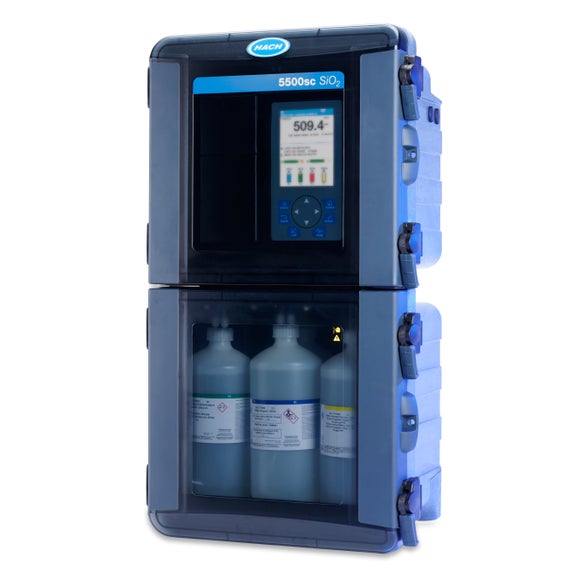
The most important parameters are: conductivity, pH, sodium and silica concentration and as the primary corrosion parameter, oxygen content. Our Orbisphere K1100 optical sensor (used in conjunction with the 410 transmitter) and the new portable Orbisphere 3100 provide continuous oxygen monitoring. Both are based on the innovative LDO technology.
Demineralisation of raw water or condensate water is an important element in the production of boiler feed water. Dissolved minerals/salts can be deposited on heating surfaces, in pipes or on turbine blades, causing significant damage. The functionality of ion exchangers can be monitored continuously by measuring parameters such as the conductivity or silicate content with the Polymetron 9210.